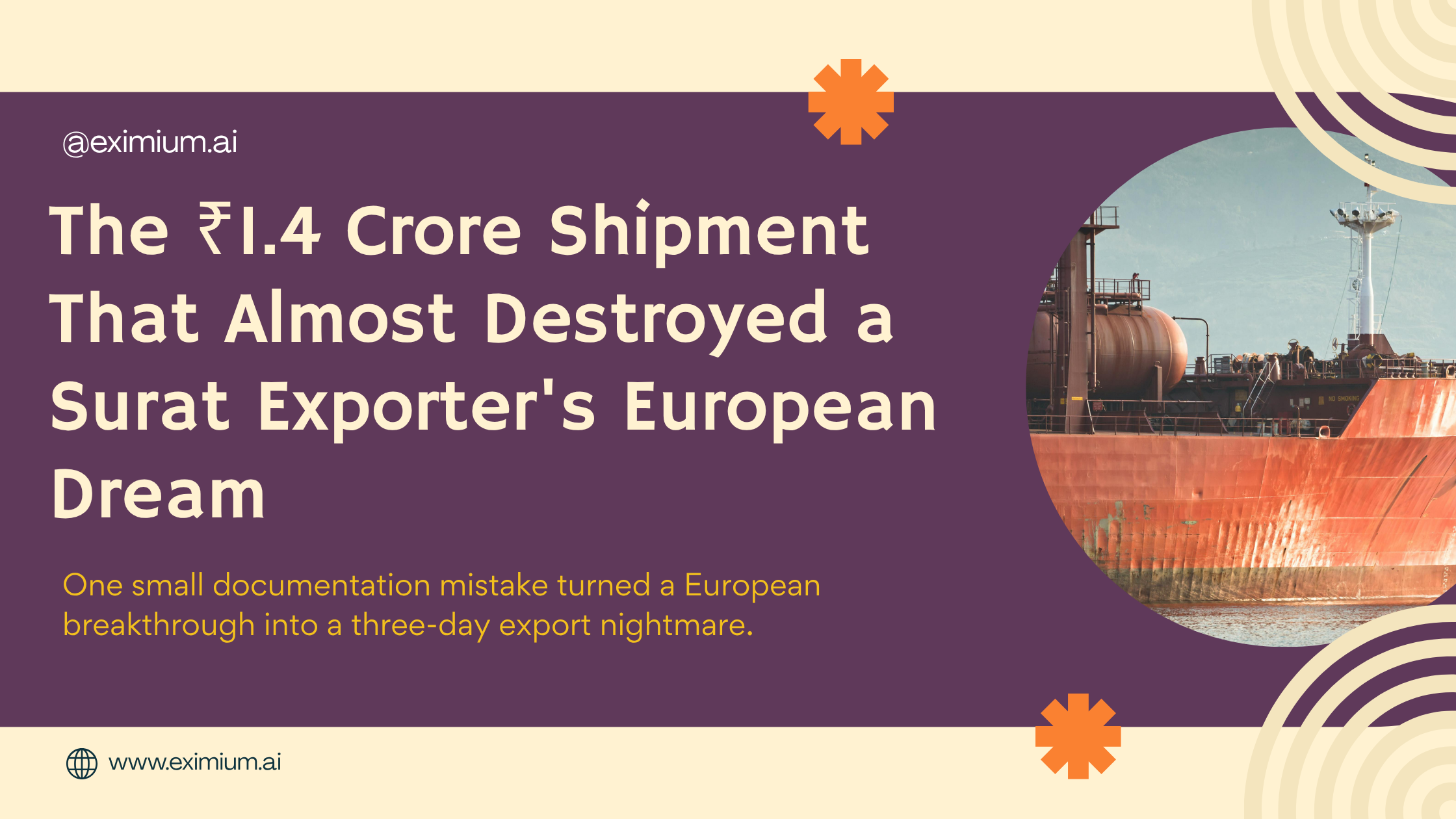
The Call That Changed Everything
At 2:17 AM Arjun Mehta’s phone rang. He was still awake. The factory had been silent for hours. His office lights were still on. A finished cup of chai sat beside his laptop. His wife had already called asking when he was coming home.
He had replied that he would be home in thirty minutes. That was not going to happen now.
Like exporters he was used to working late at night. What he was not used to was getting calls from his freight forwarder at 2 AM.
The screen on his phone flashed: Rajan Pillai.
For a moment Arjun stared at it. Then he answered.
“Hello?”
There was a pause.
“Arjun bhai…” Something did not sound right.
“We have a problem.”
The words hit harder than expected. Every exporter knows that problems rarely arrive during office hours. They arrive at night. When banks are closed. When customs officers are not answering emails. When buyers are asleep in time zones.
When there is very little you can do except worry.
“What happened?” Arjun asked.
“The Rotterdam container has been stopped.”
Arjun sat upright.
“What do you mean stopped?”
“Dutch customs has flagged it for inspection.”
The silence that followed felt longer than it actually was.
A shipment worth ₹1.4 crore was sitting thousands of kilometres away in a port.. Nobody knew how long it would stay there.
A Shipment That Meant More Than Revenue
- For corporations a delayed shipment is an inconvenience. For a -sized exporter it can become a crisis.
- The container carried 18,000 metres of georgette fabric destined for a Dutch importer. It was not another order.
- It was their European shipment of the year. A buyer they had spent months building trust with.
- A buyer who had hinted that larger orders could follow if everything went smoothly.
- A buyer that could open doors across Europe. Now all of that was hanging in the balance.
- Arjun looked at the shipment schedule pinned on his office wall. The buyer needed the goods by Friday. It was already Tuesday. Every hour mattered.
How A Surat Company Reached Europe
Mehta Poly Exports was not a corporation. It started with a loom.
- In 1991 Arjun’s father rented a shed near Ring Road in Surat and began manufacturing fabric with a handful of workers.
- There were no systems. No software. No export consultants. No global buyers.
- Just hard work. Over three decades the company grew. One loom became ten. Ten became fifty.
- Domestic buyers became buyers. The company started exporting to the Middle East, Africa and eventually Europe.
- Arjun had inherited not only the business but also his fathers relentless work ethic.
- The challenge was that global trade had changed dramatically. Hard work alone was no longer enough.
The Dream Called Europe
- Eight months before the Rotterdam incident Arjun had decided to diversify beyond markets.
- The global trade environment was becoming unpredictable. Tariffs were changing. Competition was increasing.
- Margins were shrinking. Europe looked attractive. Strong demand. Reliable buyers. Better pricing.
- Long-term contracts. At a trade exhibition Arjun met representatives from a textile importer.
- Conversations turned into meetings. Meetings turned into samples. Samples turned into an order.
- For months the team celebrated the breakthrough. Europe was no longer a target market. It was becoming a market.
- So they thought.
The Emergency Meeting
- By 9 AM in the morning the conference room was full. Arjun. His accountant Suresh.
- Documentation executive Priya. Operations head Vikram.. A trade compliance consultant named Nisha who had driven from Ahmedabad after receiving an urgent call.
- Nobody looked relaxed. Suresh was already calculating losses. Priya looked exhausted.
- Vikram had not stopped checking his phone. Nisha quietly listened. Then she asked a question.
- “What HS code did you use?” Priya opened the shipment documents. Nisha reviewed them.
- Three seconds passed. Then five. Then ten. Nobody liked the expression on her face.
- “This could be the issue.” The room fell silent.
The Small Mistake Nobody Noticed
- For months the team had been focused on production schedules, quality checks, shipment timelines and buyer communication.
- Nobody had questioned the HS code. It was copied from shipments.
- The same process they had always followed. The same method that had worked before.
- Europe was not another market. European customs authorities required specific classification.
- The product description and classification did not align perfectly. That small mismatch had triggered scrutiny.
- Now customs officials wanted explanations.
Three Sleepless Days
- The next seventy-two hours felt endless. Emails. Phone calls. Document requests.
- Technical reports. Product specifications. Lab certificates. Customs queries.
- Every hour a new request arrived. Every response created another question.
- Meanwhile the Dutch buyer kept asking for updates. At first the messages were polite.
- Then they became concerned. Eventually they became direct.
- “We need confirmation.” “Our customer is waiting.” “We cannot delay longer.”
- Arjun understood their frustration. If he were the buyer he would feel the way.
The Pressure Nobody Sees
- People often imagine exporting as glamorous. International buyers. Foreign markets.
- Global opportunities. What they do not see are moments like this. The anxiety. The uncertainty.
- The responsibility. While customs officials were reviewing paperwork in Rotterdam Arjun was sitting in Surat wondering how he would explain things if the shipment was rejected.
- The company had recently invested in machinery. Working capital was tight.
- Payroll obligations were approaching. A delayed payment would hurt. A cancelled order would hurt more.
- For the time in years he found himself questioning decisions he had been confident about only weeks earlier.
A Difficult Realization
- On Wednesday evening Arjun finally reached home. His wife Kavya placed dinner on the table.
- Neither spoke much. After a minute she asked: “Do you actually know why this happened?”
- Arjun started explaining customs procedures. Documentation. Europe. Compliance.
- She interrupted him. “No. I mean do you know why your company was not prepared for this?”
- The question stayed with him. Because the truth was uncomfortable.
- The problem was not Rotterdam. The problem was not customs.
- The problem was that they had entered a market using outdated systems.
- Many decisions depended on assumptions. Much information lived inside spreadsheets.
- Many processes were manual. Everything worked until something went wrong.
- Then everything became chaotic.
The Email That Brought Relief
- Thursday morning. 7:42 AM. A new email arrived. Arjun opened it immediately.
- Customs had accepted the revised documentation. The shipment would be released.
- The goods would move. The buyer would receive the order. For a moment nobody in the office said anything.
- Then the entire room exhaled. Three days of stress disappeared instantly.
- The shipment would survive. The buyer relationship would survive. The company would survive.
But The Lesson Remained
- A week later Nisha returned to Surat. Not to solve a crisis. To investigate how the crisis happened.
- What she found everyone. Documentation was largely manual.
- Buyer discovery depended on trade fairs and referrals. Market research was almost non-existent.
- Shipment coordination happened across emails, WhatsApp groups and spreadsheets.
- Several older shipments contained classification risks that had simply never been discovered.
The Rotterdam incident was not luck. It was a warning.
- A warning that the company needed visibility, better systems and better trade intelligence.
- From Guesswork To Intelligence
- That realization eventually led Arjun to Eximium. What interested him was not automation.
- It was not technology. It was not AI. It was information. The ability to understand markets before entering them.
- Verify buyers before pursuing them. Validate documentation before shipping.
- Track operations before problems emerged. For the time the company began making decisions based on intelligence rather than assumptions.
- That changed everything.
The Real Lesson For Exporters
- Most export crises do not begin at customs. They begin weeks earlier.
- With missing information. Unchecked assumptions. Outdated processes.
- Decisions made without visibility. The Rotterdam shipment survived.
- Many do not. Every year exporters lose buyers, money and opportunities because of documentation mistakes, compliance gaps and preventable errors.
- The difference between companies that recover and those that struggle is rarely size.
- It is preparation. Because in trade the shipment that looks perfect on paper can still become a nightmare thousands of kilometres away.
When that midnight phone call comes, the companies with the right systems are usually the ones that sleep better.
About Eximium
Eximium is an AI-powered trade ecosystem that helps exporters discover opportunities to connect with verified buyers, automate documentation, manage compliance and build smarter export operations.
Learn more at www.eximium.ai